Feature Articles
Issuance of Orders Under the Internal Security Act (ISA) against two Singaporeans, and updates on previous ISA orders
24 June 2026
In March 2026, two self-radicalised male Singaporeans, 30-year-old Tarmizi bin Mohd Taha (Tarmizi) and 19-year-old Cyrus Dzulqarnain Al-Shahriar (Cyrus), were issued with an Order of Detention (OD) and a Restriction Order (RO) under the Internal Security Act (ISA) respectively. While their cases are not related, both their radicalisation was triggered by the ongoing Israeli-Palestinian conflict.
In March 2026, two self-radicalised male Singaporeans, 30-year-old Tarmizi bin Mohd Taha (Tarmizi) and 19-year-old Cyrus Dzulqarnain Al-Shahriar (Cyrus), were issued with an Order of Detention (OD) and a Restriction Order (RO)[1] under the Internal Security Act (ISA) respectively. While their cases are not related, both their radicalisation was triggered by the ongoing Israeli-Palestinian conflict.
2. Tarmizi, a customer service officer, was a staunch supporter of HAMAS who aspired to travel to the Palestinian territories to join HAMAS. He indicated that he would be willing to undertake armed violence against Israel or conduct attacks in Singapore, if instructed by HAMAS. Cyrus, a student, was self-radicalised online by Composite Violent Extremism (CoVE).[2] He subscribed to pro-HAMAS, anti-LGBTQ and anti-Western beliefs, and was influenced by Islamist accelerationism[3] and violent incel[4] ideologies.
Tarmizi bin Mohd Taha
Radicalisation Process
3. Tarmizi became deeply interested in the Israeli-Palestinian conflict following HAMAS’s 7 October 2023 attacks against Israel and went online to search for more information. He joined several social media channels that discussed the conflict and HAMAS. Through these channels, he was exposed to HAMAS propaganda, which he would frequently rewatch.[5]
4. By February 2024, Tarmizi had come to view HAMAS as defenders of the Palestinians. He believed that it was legitimate to engage in armed violence against “enemies” and “disbelievers” responsible for oppressing Palestinians in their homeland, which he identified as Zionists, Jews and non-Muslims. Tarmizi would frequently post pro-HAMAS material on social media to garner support for HAMAS and its cause.
Plans to Travel to the Palestinian Territories to Join HAMAS and Willingness to Carry Out Attacks in Singapore
5. Tarmizi had discussions about HAMAS’s operations in Gaza with an online foreign contact who claimed to be a HAMAS member. In late 2024, Tarmizi’s contact offered to help him to travel to the Palestinian territories to join HAMAS. Tarmizi considered the offer but did not follow up on it at the time. In August 2025, he watched a video of a Palestinian being killed; this sparked a strong sense of outrage and re-triggered his earlier intent to join HAMAS. In preparation to travel to the Palestinian territories, Tarmizi renewed contact with the purported HAMAS member to seek advice and searched online for travel routes, but had yet to proceed further as he lacked the financial resources.
6. Tarmizi intended to link up with HAMAS officials in the Palestinian territories and to take a bai’ah (pledge of allegiance) to HAMAS in person. He indicated that if instructed by HAMAS, he would be willing to engage in armed combat against Israel or carry out attacks in Singapore. He also intended to utilise the skills and experience he gained during his National Service in the Singapore Police Force to contribute to HAMAS, believing that such actions would ultimately lead him to achieving martyrdom.
7. Tarmizi is assessed to pose an imminent security threat warranting detention under the ISA, given his staunch support for HAMAS, his communication with a foreign HAMAS member to facilitate his plans to travel to the Palestinian territories, and his readiness to undertake armed violence overseas and in Singapore in support of HAMAS’s cause.
Cyrus Dzulqarnain Al-Shahriar
Radicalisation Process
8. In 2022, Cyrus joined several online groups which discussed religious topics, to learn more about Islam. However, in these groups, he was exposed to anti-Western and anti-LGBTQ content. He subsequently made online posts inciting violence against the LGBTQ community.
9. Following HAMAS’s 7 October 2023 attacks against Israel, Cyrus was exposed to a proliferation of pro-HAMAS narratives online. He came to support HAMAS and their violent actions, including their killing of civilians, which he viewed as a form of jihad. In 2024, he had considered travelling to Gaza to join HAMAS and take up arms against Israelis on the frontlines of the conflict in Gaza. However, he did not make preparations to do so, as he lacked the resources to travel overseas and was fearful of engaging in physical violence.
Involvement in an Online Islamist Extremist Group
10. In mid-2024, Cyrus came across social media posts by members of a niche online Islamist extremist group which subscribed to violent accelerationist thinking. The group believed in creating “chaos” through the use of violence if necessary, to establish a future with Islam as the leading global civilisation. They believed that they needed to destroy the current “world order”, where first world countries, including Singapore, were considered an extension of the United States, and under the control of Zionists.[6]
11. After interacting with members of the aforementioned group on social media, Cyrus was invited to its private online chat group in early 2025. Influenced by the group’s support for Hay’at Tahrir al-Sham (HTS)’s offensive against then-Syrian President Bashar al-Assad’s regime, prior to its collapse in December 2024, as well as HAMAS’s 7 October 2023 attacks, he began supporting HTS and his support for HAMAS intensified. He also grew supportive of terrorist attacks that targeted Westerners, such as Al-Qaeda’s 9/11 attacks in 2001 and the 2002 Bali Bombings, and made online posts glorifying these attacks.
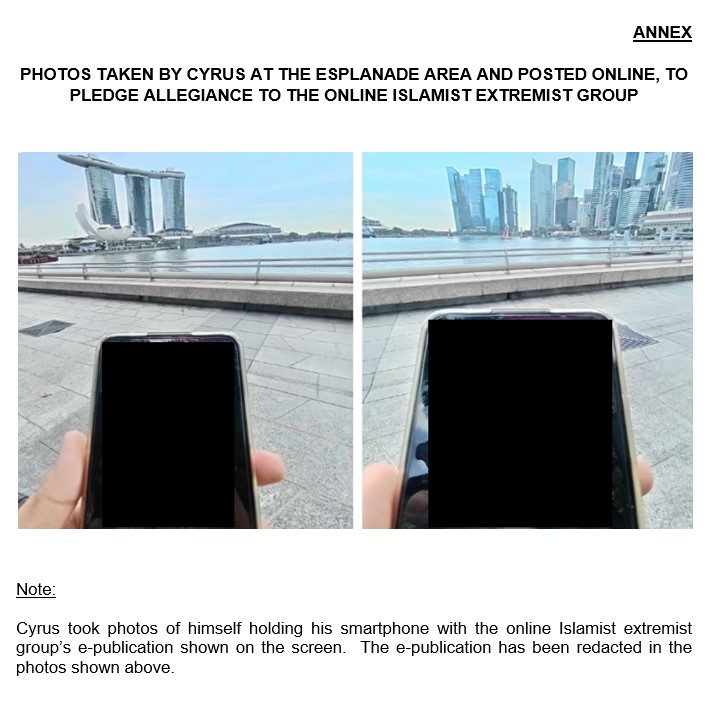
12. At the request of one of the group’s members, Cyrus went to the Esplanade area on two occasions to take photos of an e-publication authored by members of the group, with Marina Bay Sands in the background (see Annex for the photos taken by Cyrus). Inspired by the process of bai’ah among jihadist terrorist organisations, Cyrus pledged allegiance to the group by publicly posting these photos on his social media account in November 2025. He thereafter saw himself as a member of the group. He saw it as his duty to participate in the group’s “digital jihad” efforts which involved harassing users online who were deemed to be anti-Islam, to “combat American and Zionist movements”. Taking his cue from other members of the group, he posted fake news on social media to defame such users, and incited violence against them. He also made online posts glorifying HTS and HAMAS.
Subscription to Violent Incel Ideologies and Support for School Shooters
13. In early 2025, Cyrus came across content online on school shooter Elliot Rodger (Rodger),[7] and became intrigued by his incel inclinations. After perusing online incel forums, he came to identify as an incel.[8] He made online posts threatening to kill or rape women, using derogatory incel terminology (i.e. “foid”, or female humanoid) to refer to them. He also grew supportive of Rodger and other school shooters, through consuming true crime content.[9] He fantasised about committing violence against certain groups of people in school, including LGBTQ individuals and couples in relationships. However, these thoughts did not progress beyond ideation. He had not shared his extremist views or violent ideations with his family or schoolmates.
14. While Cyrus did not take preparatory steps to execute his violent ideations, his support for terrorist and extremist groups, and his online postings inciting violence against others, are of security concern. As such, he has been placed on a RO for ISD to monitor him and put him through a rehabilitation regime to address the radical beliefs that he has imbibed.
Continued Radicalising Impact of Overseas Conflicts
15. These two cases demonstrate how grievance-fuelled extremist narratives on the Israeli-Palestinian conflict continue to radicalise Singaporeans, even though it has been almost three years since the re-escalation of the conflict in October 2023. Tarmizi and Cyrus are the seventh and eighth Singaporeans dealt with under the ISA, whose radicalisation was triggered or accelerated by the Israeli-Palestinian conflict since its re-escalation.[10] Both came to support HAMAS after exposure to pro-HAMAS narratives online, and aspired to travel to Gaza to join the group. Tarmizi was further willing to conduct attacks in Singapore, if instructed by HAMAS to do so.
16. While Singaporeans remain deeply concerned about the humanitarian cost of the conflict, it is critical that we do not allow extremist narratives capitalising on foreign conflicts to take root in our society. ISD will take firm action against any individual in Singapore who supports, promotes, undertakes or makes preparations for armed violence, regardless of how they rationalise such violence ideologically or where the violence takes place.
Growing Diversity of Violent Extremist Ideologies
17. Cyrus’ case also underscores the growing diversity of violent extremist ideologies fuelling the domestic self-radicalisation threat, especially amongst youths. Beyond our concerns with Islamist extremism and far-right extremism, Cyrus is the second individual radicalised by CoVE to be dealt with under the ISA.[11] The trend of CoVE reflects a broader shift in how one can become radicalised in the digital age, given the ease in which one can consume and engage with a diverse range of contents on news sites, social media platforms and other online information channels. Those radicalised by CoVE draw selectively from multiple extremist ideologies to construct their personalised worldview or hybrid belief system that justifies violence. The lack of a coherent worldview does not diminish the severity of the CoVE threat.
Importance of Public Vigilance and Early Reporting
18. Anyone, regardless of demographic profile, is susceptible to radicalisation. ISD reminds the public to remain vigilant to signs that someone around us may have become radicalised, and seek help from the authorities early. Doing so allows the suspected radicalised individual to get the help they need, and keeps society safe. Fortunately, in the case of Cyrus, a member of the public had reported his extremist online postings which espoused anti-Semitic and pro-HAMAS views to ISD. Possible signs of radicalisation include, but are not limited to, the following:
a. Displaying signs or symbols of extremist/terrorist groups (e.g., displaying HAMAS’s flag as one’s social media photo);
b. Frequently surfing radical websites;
c. Posting/sharing extremist views on social media platforms, such as expressing support/admiration for terrorists/terrorist groups as well as the use of violence;
d. Sharing extremist views with friends and relatives;
e. Making remarks that promote ill-will or hatred towards people of other races, religions or communities;
f. Expressing intent to participate in acts of violence overseas or in Singapore; and/or
g. Inciting others to participate in acts of violence.
19. Anyone who knows or suspects that a person has been radicalised, or is involved in terrorism-related activities, should promptly contact ISD at 1800-2626-473 (1800-2626-ISD).
Updates on Cases under the Internal Security Act
Release from Detention
20. Singaporean Radjev Lal s/o Madan Lal (Radjev), aged 33, was released from detention on a RO under the ISA in April 2026. Radjev was detained in April 2022, after investigations found that he was self-radicalised and had made preparations to travel to overseas conflict zones to undertake armed violence. He has shown good progress in his rehabilitation and was assessed to no longer pose an imminent security threat requiring preventive detention.
Lapse of Restriction Orders
21. The ROs issued against three Singaporeans were allowed to lapse upon their expiry as they had made good progress in their rehabilitation, and no longer require close supervision under the RO regime:
a. Abd Rahim bin Abdul Rahman (aged 57), a former Jemaah Islamiyah (JI) member who was detained in March 2012. He was released from detention on a Suspension Direction (SD)[12] in March 2019. He was subsequently issued with a RO in March 2020, which was allowed to lapse in March 2026.
b. Mohamed Faishal bin Mohd Razali (aged 35), who was self-radicalised and wanted to undertake armed violence overseas in various conflict zones, including Syria. He was detained in April 2018, and released from detention on a SD in May 2021. He was subsequently issued with a RO in April 2022, which was allowed to lapse in April 2026.
c. Husaini bin Ismail (aged 67), a former JI member who was detained in June 2012. He was released from detention on a RO in June 2020, and his RO was allowed to lapse in June 2026.
INTERNAL SECURITY DEPARTMENT
24 JUNE 2026
[1] A person issued with a RO must abide by several conditions and restrictions. For example, the individual is not permitted to change his or her residence or employment, or travel out of Singapore, without the approval of Director ISD. The individual also cannot access the Internet or social media, issue public statements, address public meetings or print, distribute, contribute to any publication, hold office in, or be a member of any organisation, association or group, without the approval of Director ISD. Individuals under the RO regime will also undergo a holistic rehabilitation programme, which includes religious, psychological and social rehabilitation. It aims to correct the radical ideologies they have imbibed, reduce their vulnerability to radical influences, and facilitate their reintegration into society.
[2] CoVE, which ISD has previously referred to as ‘salad bar’ extremism, refers to a form of violent extremism where individuals subscribe to multiple, and sometimes conflicting, extremist ideologies, rather than adhering to a coherent or unified worldview. This results in a personalised composite belief system, which the individual uses to justify violence. The term CoVE is aligned with more current literature on this ideological typology.
[3] Accelerationism, in the extremist context, promotes the hastened collapse of modern societal structures and political systems, often through the use of violence, based on the perception that the current world order is flawed or “broken”. The term was popularised by, and often associated with, the white supremacist movement, although it has also been appropriated by other extremist elements. In Cyrus’ case, he was influenced by a strand of Islamist accelerationism which encouraged the use of violence to hasten societal collapse, to then establish Islam as the leading global civilisation.
[4] Incel, short for “involuntary celibate”, refers to a subculture of individuals, mostly men, who identify as unable to find a romantic or sexual partner despite desiring one. The incel community often expresses frustration, anger, and resentment towards society, women, and those they perceive as more sexually successful. Some incel ideologies have been linked to misogyny, violence, and extremism.
[5] This included content on HAMAS fighting against Zionists and speeches by the former spokesperson of HAMAS’s military wing Al-Qassam Brigades, Abu Obaidah. Abu Obaidah was reportedly killed in an airstrike in August 2025.
[6] There are no other known Singaporeans involved in the group and no indication of an imminent threat against Singapore.
[7] Rodger was the perpetrator of the 23 May 2014 Isla Vista killings in California, U.S. which killed six and injured 14 others. His attacks, which are widely praised in the incel community, were said to stem from resentment over his bullying, social isolation and rejection by women.
[8] Unhappy over his inability to pursue romantic relationships, Cyrus subscribed to incel beliefs such as “looksmaxxing” (an incel subculture which provides solutions on how to enhance one’s physical appearance) and the “black pill” theory (the incel belief that some men are destined for romantic failure and will never find a romantic partner).
[9] True crime refers to a genre of media that focuses on real-life criminal cases, often involving violent or sensational offences like murder, assault or serial killings. While such content is consumed by a broad audience, true crime content shared by “True Crime Community” (TCC) groups, which are associated with nihilistic violent extremism, glorify mass killers and normalise violence. There have been reports of TCC-linked violence overseas.
[10] The six prior cases are:
a) A then-14-year-old youth, who was issued with a RO in June 2024. Please refer to ISD’s press release dated 15 Jul 2024 for details.
b) Then-33-year-old An’nadya binte An’nahari and then-56-year-old Hamizah binte Hamzah, who were issued ROs under the ISA in July 2024 and January 2025 respectively. Please refer to ISD’s press releases dated 15 Jul 2024 and 10 Feb 2025 for details.
c) Then-21-year-old Muhammad Indra Aqmal bin Effendy, then-41-year-old Mohamad Latiff bin Rahim, and then-44-year-old Nurisham bin Yusoff, who were detained under the ISA in November 2024. Please refer to ISD’s press release dated 9 Jan 2025 for details.
[11] The first was a then-14-year-old who was issued with a RO in September 2025. He was an Islamic State in Iraq and Syria (ISIS) supporter, who concurrently subscribed to anti-Semitic beliefs espoused in far-right extremism, and identified as an incel. Please refer to ISD’s press release dated 9 Sep 2025 for details.
[12] A Suspension Direction (SD) is a Ministerial direction to suspend the operation of an existing Order of Detention. The Minister for Home Affairs may revoke the SD and the individual will be re-detained, if he does not comply with any of the conditions stipulated in the SD. The SD conditions are similar to the RO conditions.